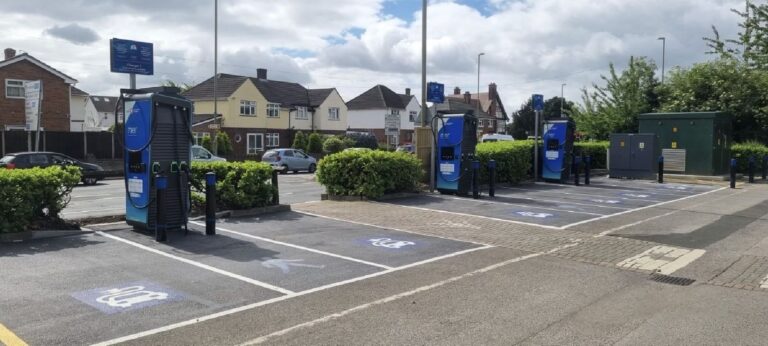
As electric vehicle (EV) adoption continues to gain traction in the UK, retail destinations are emerging as some of the most strategically valuable locations for public charging infrastructure.
Unlike petrol vehicles which can be refuelled in five minutes, EV charging is time consuming. This means that locations which are already appealing to spend time in, such as retail destinations, are often the preferred places for EV drivers to charge at. In Mer’s latest customer survey, we found that while charging their car, 59% of our drivers prefer to go shopping or eat at a restaurant or cafe.
However, every retail destination is different, so the EV charging solution must be designed accordingly. In this article, we will explore the different kinds of retail destinations and the possible charging solutions for each one.
It’s all about power
The first and most important consideration before installing EV chargers is power. EV chargers require a lot of energy. Our public charging team always starts by examining the existing grid connections of your site. If you receive sufficient power from the national grid, then we can avoid any costly and time-consuming grid upgrades.
However, even if you don’t quite have the power requirements, there are workarounds. One option is to implement load balancing technology, which carefully manages the distribution of power between several chargers. This means that depending on the usage, the power consumption can be adjusted between them. The chargers are thus able to deliver an efficient charge for each vehicle, while simultaneously avoiding strain on the electrical infrastructure.

What’s on-site?
Once we have established a secure power supply, our team advises what sort of EV charging infrastructure should be installed. For any retail destination EV charging solution, it’s important to examine the businesses and amenities on your site. This will determine what blend of fast and rapid chargers will be included in the solution.
Whether they are indoor shopping centres, or open-air retail parks, these locations represent some of the best locations for the installation of EV chargers. This is because they receive a high volume of traffic, combined with a longer average dwell time to other locations.
When you look at the customer behaviour of retail park visitors, their visit often lasts from one to three hours. This means that an equal blend of fast and rapid chargers can cater to a wide range of people. Visitors who are in a hurry for a targeted visit to one retailer could use one of the energy-intense rapid chargers, while those who are looking to browse for a longer period of time could utilise a fast charger instead.
Retail parks which have a wide variety of businesses on-site reach a wider audience of EV drivers. A blend of shopping and food establishments means that there will be a steady stream of customers throughout the day and week. This variation in customers necessitates a variety of charger types.
Retail parks and shopping centres also benefit from having large, accessible car parks or multi-level parking facilities where designated charging zones can be easily managed. This mitigates any potential impacts on traffic, whilst the larger bay sizes means that the chargers themselves stay compliant with UK accessibility standards.
Supermarkets are another key location for EV chargers, but there are a few key differences to retail parks. Firstly, the average grocery shopping trip rarely exceeds an hour, even in big box stores. A higher proportion of rapid chargers is recommended in this situation – since the dwell time is lower, people do not want to wait around. Often supermarkets already have stronger grid connections to support these more intensive chargers due to the existing energy demands of large refrigeration units.
Meanwhile, supermarkets are less likely to be used by long-distance travellers since they largely serve their local community. Local visitors are not going to be recharging from empty and are instead looking for a weekly top-up. This means that there is a higher turnover of charge point users. Our team might recommend installing a few high-power rapid chargers, rather than lots of fast chargers.

Outlet villages, garden centres and leisure parks
While the tenants present on-site vary wildly, outlet villages, garden centres and leisure parks have many features in common. An average visit to any of these locations can range from three hours to several depending on their size, which means that fast chargers will best cater for these visitors, since charging speed is not as much of an issue.
Fast chargers also suit these locations better, since they tend to be located outside of built-up areas. Often more isolated areas need grid connection upgrades to power rapid chargers, but you can avoid this by focusing on fast chargers and making smart use of load balancing. Outlet villages and leisure parks are usually open well into the evening, allowing both drivers and site owners to take advantage of the power supply outside of peak hours.
These locations are not focused on the local community alone. They are potent attractors for customers in a much wider area. This means that generally people must travel further, therefore they are more likely to need to charge their battery for longer due to the higher rate of depletion.
Our team at Mer have over nine years of experience planning and installing EV charging at a wide range of retail locations. However, as every site is unique, the strategies outlined above are not applicable to every location. For more information about how the nuances of your site determine the size and profile of your EV charging solution, download our latest EV charging hubs guide.

For more information please visit the Mer website or email us at info.uk@mer.eco