What steps is the retail property industry taking to reduce its carbon footprint?
A Net Zero carbon building, as defined by The UK Green Building Council (UKGBC), is a building where the amount of carbon emissions associated with a building’s operational energy on an annual basis is zero or negative, and is highly energy-efficient and powered from onsite and/or off-site renewable energy sources, with any remaining carbon balance offset.
At present, existing buildings contribute to around 40 per cent of the UK’s total carbon emissions annually. In order to do its part in the race to Net Zero, the retail property industry is working to take proactive, systemic steps to find solutions which reduce reliance on fossil fuels and pave the way to carbon neutrality.
Energy use in retail varies significantly depending on the building’s fabric and age. Sophie Chick, head of the department of world research at property advisers Savills says that there are some common themes that impact carbon emissions for all retail buildings, including bright lighting, doors being left open leading to energy waste, and for those which F&B operators, electricity used in refrigeration.
Whilst many are implementing solutions to improve carbon efficiency for these necessary evils, their power guzzling remains ultimately unavoidable. A better area to focus on in improving sustainability could be one of retail’s more pressing issues: repurposing retail.
The UK currently has 142 million sq ft of vacant retail space, equivalent to 12.6% of retail units – all of which have the potential to be converted into residential, co-working space or anything else which could help breathe life back into town centres. How this repurposing is done can have a significant impact on carbon emissions.
“The decision of whether to retrofit or rebuild will be looked at from many angles – viability, planning regulations, demand – but the environmental impact should also be a central consideration in decision-making,” says Chick.
“In most cases, a retrofit will result in less emissions but it is not always the cheapest or easiest option and may depend on the sector. For example, a typical department store requires less structural change to retrofit into co-working space than residential dwellings and therefore less carbon is emitted.”
Commercial property landlord British Land, whose owned and managed portfolio is worth over £13bn in retail and office assets, recently announced a ‘Science Based Target initiative’, which would reduce direct and indirect greenhouse gas emissions 51% by 2030 from its 2020 levels, and reduce emissions 55% per sqm of net lettable area over the same target timeframe.
Last December, British Land set out its Pathway to Net Zero Carbon identifying the practical steps it would take over the next ten years to deliver on its goals including: net zero carbon asset audits; a £60 levy on embodied carbon in new developments; and reducing carbon in new build developments by prioritising re-use
“These are stretching targets, but technology can play a key role in optimising energy usage and our team is highly experienced at finding new and innovative ways to make our space more efficient,” says Matthew Webster, head of portfolio sustainability at British Land. “We recognise the urgent need to be ambitious in the environmental goals we set ourselves and are supported in this by our customers, partners, suppliers and people.”
Marco-level changes will be the big influencers in the climate crisis, but micro-level personal changes and actions play an equally important role in the broader picture of a sustainable world.
Global investment manager Schroders challenged its employees to think about their #EarthDayImpact by considering six lifestyle changes: going electric, choosing eco-friendly travel, eating sustainable, reducing fast fashion, spending responsibly, and adventuring locally. Some of the team have taken steps beyond this in their personal investments.
“I’m cautious about where my money goes and its purpose,” says Frederic Brindeau, head of asset management for infrastructure debt at Schroders. “I’m keen to allocate part of my investment towards start-ups with strong environmental impacts.
“I decided to donate 1% of my salary to social and environmental organisations. Being consistent on sustainability including on the investment side makes me feel good. Aligning my finances to my values has felt natural.”
It is very possible to make an impact not just among employees, but with shoppers, by encouraging environmental sustainability. Coniq’s senior sales manager, Alessandra Gamba, suggests implementing a green loyalty programme to help customers make small steps to protect the planet.
“For example, you could give customers a discount every time they use their own mugs in your coffee shops; or every time they recycle their old products through your recycling programs. By doing so, they will be incentivised to be environmentally friendly and want to shop in your centre more often,” she says.
Gamba also suggests promoting environmentally friendly transportation options by offering on-site electric vehicle charging points, promoting responsible consumption and production, and adopting a sustainable energy plan: “There are many ways you can. One easy-to-implement solution would be to use LED light bulbs. They are energy-efficient, long-lasting, and can cut energy consumption by 80% compared to conventional ones.”
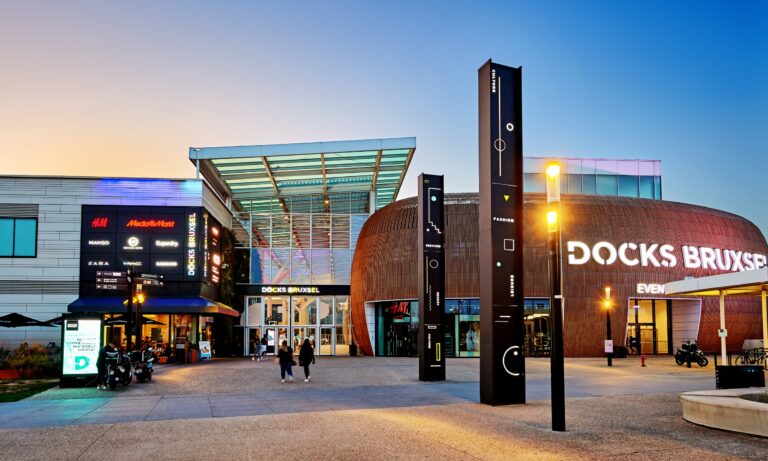
It is not just UK destinations doing their part, as illustrated by Brussels’ contemporary urban shopping centre, Docks Bruxsel, currently holds a BREEAM certificate of excellence and Portus Retail is currently working on how the centre can work towards a Net Zero status.
Ongoing initiatives at the destination include 4500 sq m of solar panels providing the centre with green energy; Natural ventilation throughout the centre due to the automatic opening glass roof system; a glass roof that reduces energy consumption; a green roof which collects rainwater which is then used for cleaning in the centre and watering plant; and an energy recovery system that saves 1,600 MWh each year, enough to heat 1,300 homes.
All tenants at the centre have also signed up to a ‘green charter’ in their lease agreement, which commits to a series of measures reducing their energy footprint. And, as part of its partnership with social enterprise BeeOdiversity, Docks is home to approximately 80,000 honeybees in the two hives on the centre’s roof.
“The sustainability of our centre and the measures taken to achieve this at Docks is an extremely important issue for us,” says Peter Todd, founder of Portus retail which manages the scheme. “This is a message we have continually reported to our customers who regularly engage with us through social media and events with our partners such as BeeOdiversity.
“The environmental impact reduction and energy saving measures we take are important to us, but also recognised and responded to by our customers.”
This was first published in Retail Destination Fortnightly. Click here to subscribe.